Showing posts with label faith. Show all posts

Apr 22, 2011

Good Friday

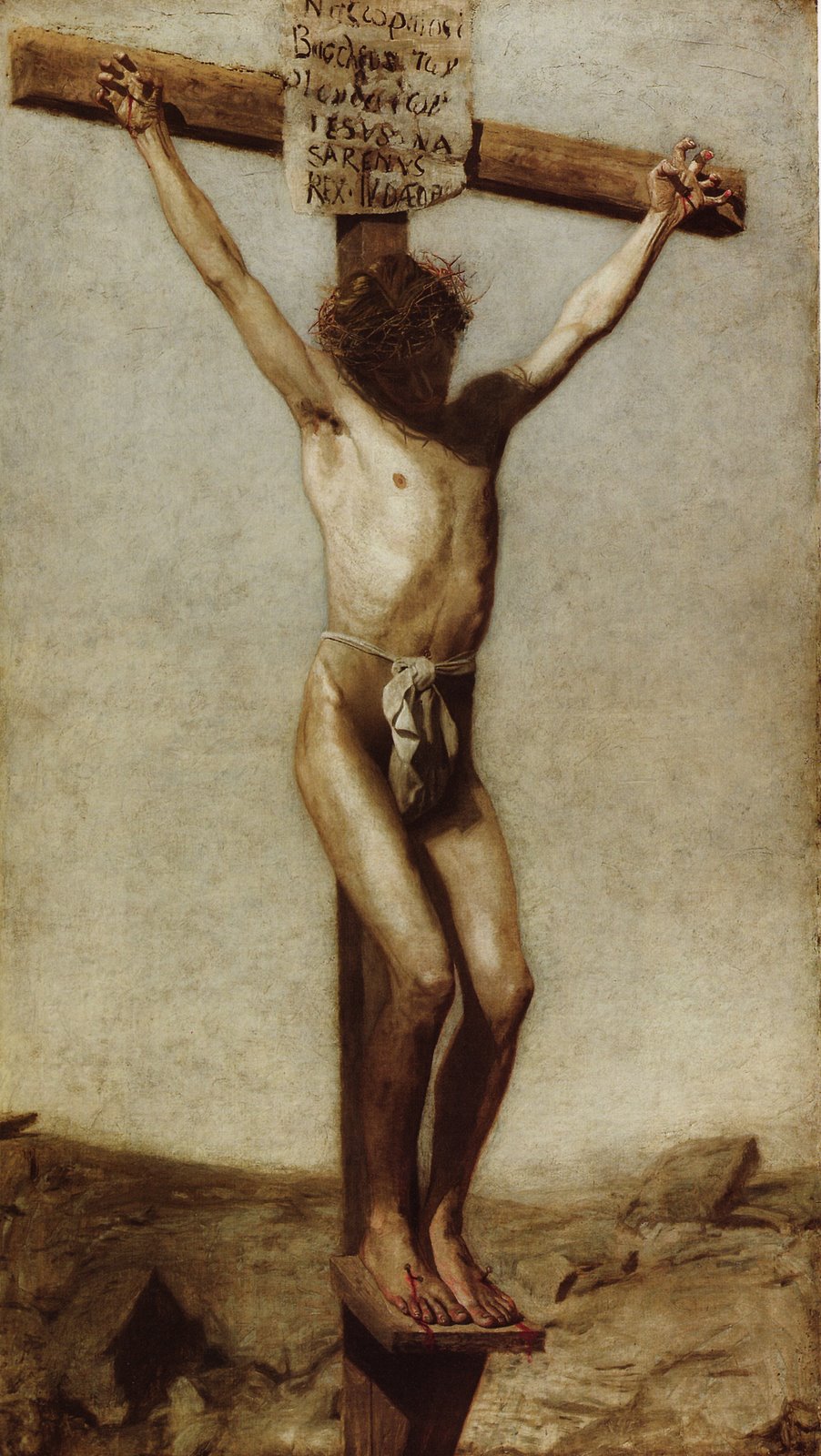
Crucifixion, Thomas Eakins

On this Good Friday, I'll let G.K. Chesterton do my talking, from The Everlasting Man:

Every attempt to amplify [the Passion] has diminished it. The task has been attempted by many men of real genius and eloquence as well as by only too many vulgar sentimentalists and self-conscious rhetoricians. The tale has been retold with patronizing pathos by elegant skeptics and with fluent enthusiasm by boisterous best-sellers. It will not be retold here. The grinding power of the plain words of the Gospel story is like the power of millstones; and those who can read them simply enough will feel as if rocks had been rolled upon them. Criticism is only words about words; and of what use are words about such words as these? What is the use of wordpainting about the dark garden filled suddenly with torchlight and furious faces? 'Are you come out with swords and staves as against a robber? All day I sat in your temple teaching, and you took me not.' Can anything be added to the massive and gathered restraint of that irony; like a great wave lifted to the sky and refusing to fall? 'Daughters of Jerusalem, weep not for me but weep for yourselves and for your children!'

As the High Priest asked what further need he had of witnesses, we might well ask what further need we have of words. Peter in a panic repudiated him: 'and immediately the cock crew; and Jesus looked upon Peter, and Peter went out and wept bitterly.' Has anyone any further remarks to offer? Just before the murder he prayed for all the murderous race of men saying 'They know not what they do'; is there anything to say to that, except that we know as little what we say? Is there any need to repeat and spin out the story of how the tragedy trailed up the Via Dolorosa and how they threw him in haphazard with two thieves in one of the ordinary batches of execution; and how in all that horror and howling wilderness of desertion one voice spoke in homage, a startling voice from the very last place where it was looked for, the gibbet of the criminal; and he said to that nameless ruffian, 'This night shalt thou be with me in Paradise'? Is there anything to put after that but a full-stop? Or is anyone prepared to answer adequately that farewell gesture to all flesh which created for his Mother a new Son?

It is more within my powers, and here more immediately to my purpose, to point out that in that scene were symbolically gathered all the human forces that have been vaguely sketched in this story. As kings and philosophers and the popular element had been symbolically present at his birth, so they were more practically concerned in his death; and with that we come face to face with the essential fact to be realized. All the great groups that stood about the Cross represent in one way or another the great historical truth of the time; that the world could not save itself. Man could do no more. Rome and Jerusalem and Athens and everything else were going down like a sea turned into a slow cataract. Externally indeed the ancient world was still at its strongest, it is always at that moment that the inmost weakness begins. But in order to understand that weakness we must repeat what has been said more than once; that it was not the weakness of a thing originally weak. It was emphatically the strength of the world that was turned to weakness and the wisdom of the world that was turned to folly.

In this story of Good Friday it is the best things in the world that are at their worst. That is what really shows us the world at its worst. It was, for instance, the priests of a true monotheism and the soldiers of an international civilization. Rome, the legend, founded upon fallen Troy and triumphant over fallen Carthage, had stood for a heroism which was the nearest that any pagan ever came to chivalry. Rome had defended the household gods and the human decencies against the ogres of Africa and the hermaphrodite monstrosities of Greece. But in the lightning flash of this incident, we see great Rome, the imperial republic, going downward under her Lucretian doom. Scepticism has eaten away even the confident sanity of the conquerors of the world. He who is enthroned to say what is justice can only ask, 'What is truth?' So in that drama which decided the whole fate of antiquity, one of the central figures is fixed in what seems the reverse of his true role. Rome was almost another name for responsibility . Yet he stands forever as a sort of rocking statue of the irresponsible. Man could do no more. Even the practical bad become the impracticable. Standing between the pillars of his own judgment-seat, a Roman had washed his hands of the world. There too were the priests of that pure and original truth that was behind all the mythologies like the sky behind the clouds. It was the most important truth in the world; and even that could not save the world. Perhaps there is something overpowering in pure personal theism; like seeing the sun and moon and sky come together to form one staring face. Perhaps the truth is too tremendous when not broken by some intermediaries divine or human; perhaps it is merely too pure and far away.

Anyhow it could not save the world; it could not even convert the world. There were philosophers who held it in its highest and noblest form; but they not only could not convert the world, but they never tried. You could no more fight the jungle of popular mythology with a private opinion than you could clear away a forest with a pocket-knife. The Jewish priests had guarded it jealously in the good and the bad sense. They had kept it as a gigantic secret. As savage heroes might have kept the sun in a box, they kept the Everlasting in the tabernacle. They were proud that they alone could look upon the blinding sun of a single deity; and they did not know that they had themselves gone blind. Since that day their representatives have been like blind men in broad daylight, striking to right and left with their staffs, and cursing the darkness. But there has been that in their monumental monotheism that it has at least remained like a monument, the last thing of its kind, and in a sense motionless in the more restless world which it cannot satisfy. For it is certain that for some reason it cannot satisfy.

Since that day it has never been quite enough to say that God is in his heaven and all is right with the world; since the rumor that God had left his heavens to set it right.

And as it was with these powers that were good, or at least had once been good, so it was with the element which was perhaps the best, or which Christ himself seems certainly to have felt as the best. The poor to whom he preached the good news, the common people who heard him gladly, the populace that had made so many popular heroes and demigods in the old pagan world showed also the weaknesses that were dissolving the world. They suffered the evils often seen in the mob of the city, and especially the mob of the capital, during the decline of a society. The same thing that makes the rural population live on tradition makes the urban population live on rumor. just as its myths at the best had been irrational, so its likes and dislikes are easily changed by baseless assertion that is arbitrary without being authoritative. Some brigand or other was artificially turned into a picturesque and popular figure and run as a kind of candidate against Christ. In all this we recognize the urban population that we know, with its newspaper scares and scoops. But there was present in this ancient population an evil more peculiar to the ancient world. We have noted it already as the neglect of the individual, even of the individual voting the condemnation and still more of the individual condemned. It was the soul of the hive; a heathen thing. The cry of this spirit also was heard in that hour, 'It is well that one man die for the people! Yet this spirit in antiquity of devotion to the city and to the state had so been in itself and in its time a noble spirit. It had its poets and its martyrs; men still to be honored forever. It was failing through its weakness in not seeing the separate soul of a man, the shrine of all mysticism; but it was only failing as everything else was failing. The mob went along with the Sadducees and the Pharisees, the philosophers and the moralists. It went along with the imperial magistrates and the sacred priests, the scribes and the soldiers, that the one universal human spirit might suffer a universal condemnation; that there might be one deep, unanimous chorus of approval and harmony when Man was rejected of men.

There were solitudes beyond where none shall follow. There were secrets in the inmost and invisible part of that drama that have no symbol in speech; orin any severance of a man from men. Nor is it easy for any words less stark and single-minded than those of the naked narrative even to hint at the horror of exaltation that lifted itself above the hill. Endless expositions have not come to the end of it, or even to the beginning. And if there be any sound that can produce a silence, we may surely be silent about the end and the extremity; when a cry was driven out of that darkness in words dreadfully distinct and dreadfully unintelligible, which man shall never understand in all the eternity they have purchased for him; and for one annihilating instant an abyss that is not for our thoughts had opened even in the unity of the absolute; and God bad been forsaken of God.

They took the body down from the cross and one of the few rich men among the first Christians obtained permission to bury it in a rock tomb in his garden; the Romans setting a military guard lest there should be some riot and attempt to recover the body. There was once more a natural symbolism in these natural proceedings; it was well that the tomb should be sealed with all the secrecy of ancient eastern sepluchre and guarded by the authority of the Caesars. For in that second cavern the whole of that great and glorious humanity which we call antiquity was gathered up and covered over; and in that place it was buried. It was the end of a very great thing called human history; the history that was merely human. The mythologies and the philosophies were buried there, the gods and the heroes and the sages. In the great Roman phrase, they had lived. But as they could only live, so they could only die; and they were dead

On the third day the friends of Christ coming at daybreak to the place found the grave empty and the stone rolled away. In varying ways they realized the new wonder; but even they hardly realized that the world had died in the night. What they were looking at was the first day of a new creation, with a new heaven and a new earth; and in a semblance of the gardener God walked again in the garden, in the cool not of the evening but the dawn.

Apr 21, 2011

Portraiture, Triduum, and Bears, oh, my!


Today marks the beginning of what the liturgical calendar calls the Easter Triduum, or "Three Days," consisting of Maundy Thursday (today), Good Friday, Black Saturday, and Easter Sunday.*

*Wait, Josh! That's four days! Excellent point. The time is counted from the night of Maundy Thursday ("the Mass of the Last Supper") until the night of Easter Sunday, for a total of three days.

Maundy Thursday is one of the most important days in the Christian year, because it was on that night that Jesus held the Last Supper, instructed the disciples on Communion, predicted Peter's denial, washed the disciples' feet, prayed in Gethsemane, and was betrayed and arrested.

The story of this night has always been very significant to me for two reasons: the institution of the Eucharist and the prayer of Jesus in Gethsemane.

The Eucharist is a deeply mystical event. 'This is my body. This is my blood. Take, eat and drink.' With this act, the faithful enter into specific communion with God in physical form through consumption of his very flesh and blood (or representations thereof). Through it, we thank all the persons of God for the sacrifices: becoming flesh, dying as an atonement for sin, and indwelling on the Earth. I can't comprehend what any of this really means, but I understand the depth of its meaning. I guess that's what makes it mystical.

Anyway, I've been wanting to practice oil painting for some time, and portraiture in particular. And the effects of dramatic lighting. So, I decided to combine all these things. It being Holy Week and all, I decided to do a portrait of Jesus. I both am happy to have done it because of the long history of beautiful Christian art and totally disgusted with myself for having potentially joined the legions of terrible Christian kitsch. Whatever.

It's a portrait (unfinished!) of Jesus breaking the bread.


So, there you go.

_______________________________


The other fascination of Maundy Thursday for me is in Gethsemane, and Christ's prayer in the garden. I'll let C.S. Lewis do my speaking:

Some people feel guilty about their anxieties and regard them as a defect of faith. I don't agree at all. They are afflictions, not sins. Like all afflictions, they are, if we can so take them, our share in the Passion of Christ. For the beginning of the Passion--the first move, so to speak--is in Gethsemane. In Gethsemane a very strange and significant thing seems to have happened.

It is clear from many of His sayings that Our Lord had long foreseen His death. He knew what conduct such as His, in a world such as we have made of this, must inevitably lead to. But it is clear that this knowledge must somehow have been withdrawn from Him before He prayed in Gethsemane. He could not, with whatever reservation about the Father's will, have prayed that the cup might pass and simultaneously known that it would not. That is both a logical and a psychological impossibility. You see what this involves? Lest any trial incident to humanity should be lacking, the torments of hope--of suspense, anxiety--were at the last moment loosed upon Him--the supposed possibility that, after all, He might, He just conceivably might, be spared the supreme horror. There was precedent. Isaac had been spared: he too at the last moment, he also against all apparent probability. It was not quite impossible...and doubtless He had seen other men crucified...a sight very unlike most of our religious pictures and images.

But for this last (and erroneous) hope against hope, and the consequent tumult of the soul, the sweat of blood, perhaps He would not have been very Man. To live in a fully predictable world is not to be a man.

....

We all try to accept with some sort of submission our afflictions when they actually arrive. But the prayer in Gethsemane shows that the preceding anxiety is equally God's will and equally part of our human destiny. The perfect Man experienced it. And the servant is not greater than the master. We are Christians, not Stoics.

....

As for the last dereliction of all, how can we either understand or endure it? Is it that God Himself cannot be Man unless God seems to vanish at His greatest need? And if so, why? I sometimes wonder if we have even begun to understand what is involved in the very concept of creation. If God will create, He will make something to be, and yet to be not Himself. To be created is, in some sense, to be ejected or separated. Can it be that the more perfect the creature is, the further this separation must at some point be pushed? It is saints, not common people, who experience the 'dark night.' It is men and angels, not beasts, who rebel. Inanimate matter sleeps in the bosom of the Father. The 'hiddenness' of God perhaps presses most painfully on those who are in another way nearest to Him, and therefore God Himself, made man, will of all men be by God most forsaken?

-Letters to Malcom, 1964

Apr 17, 2011

Egge Homo


Κατὰ Ἰωάννην 19.5
"...ἐξῆλθεν
οὖν [ὁ] Ἰησοῦς ἔξω, φορῶν τὸν ἀκάνθινον στέφανον καὶ τὸ πορφυροῦν ἱμάτιον. καὶ λέγει αὐτοῖς Ἰδοὺ ἄνθρωπος.'"

Ioannes 19:5
"...ut cognoscatis quia in eo nullam causam invenio et purpureum vestimentum et dicit eis ecce homo."

John 19:5 (ESV)
"So Jesus came out, wearing the crown of thorns and the purple robe. Pilate said to them, 'Behold the man!'"

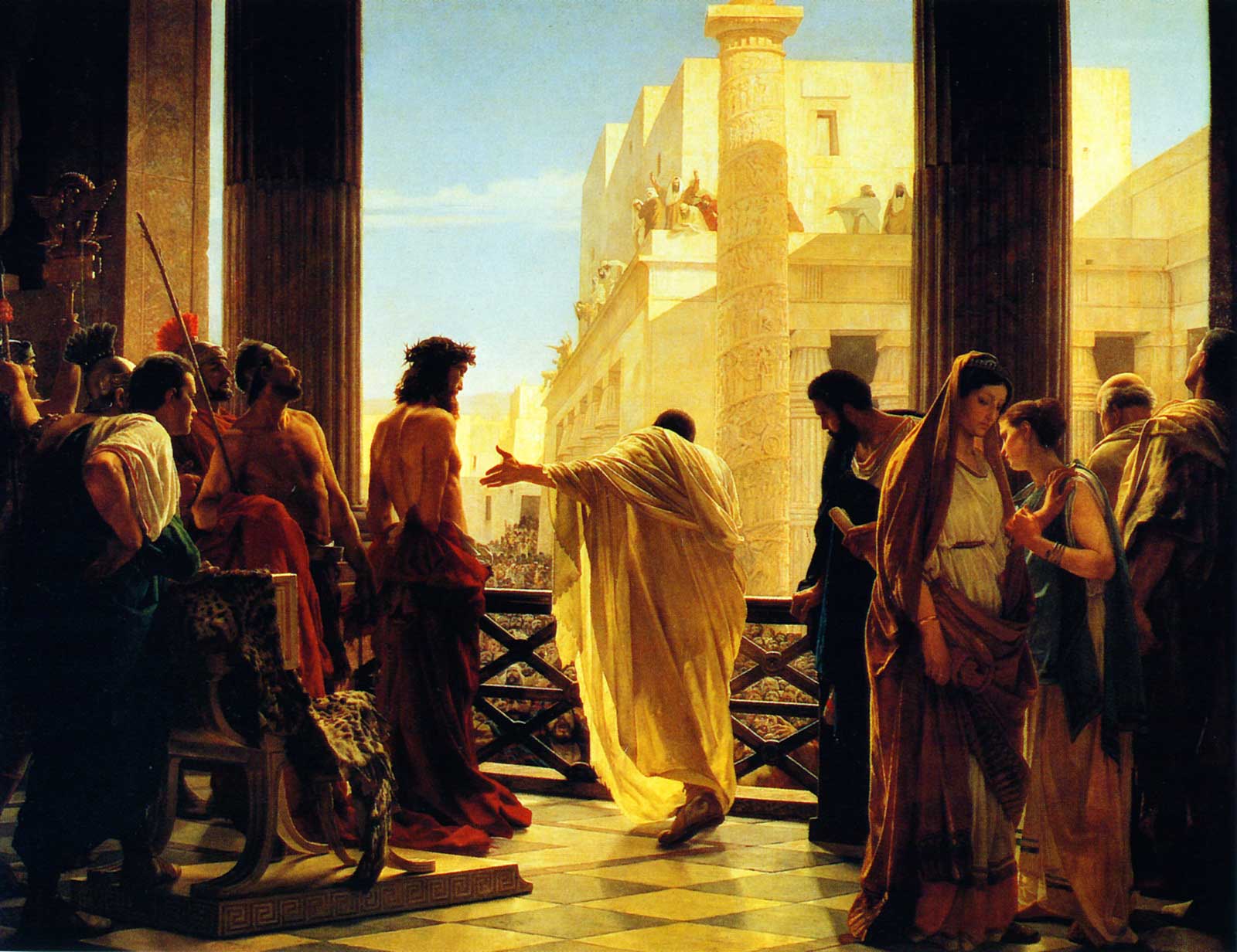
Ecce Homo, the Latin phrase for 'Behold the man' (or 'Look upon the man'), was recorded by the author of the Gospel of John as what Pontius Pilate said as he displayed the thorn-crowned, purple-robed Christ to the crowd in Jerusalem before sending him to be crucified. Actually, the gospel author recorded Pilate as saying Ἰδοὺ ἄνθρωπος (meaning, unsurprisingly, 'Behold the man'). However, the popularity in the West of the Latin Vulgate meant that Ecce Homo is the line that gained renown. Across the centuries, it has become synonymous with the trial of Jesus and the symbolism surrounding it. Artist after artist has depicted it.

My favorite piece, by far, and possibly my favorite painting, is Ecce Homo by Antonio Ciseri. It is not a stranger to this blog. The image of a thoroughly flogged and humiliated Christ, still standing, while the power of Rome, the Jewish hierarchy, and the Jerusalem mob all coalesce against him, is deeply moving. Ciseri's picture brings it all together, from the viewpoint of someone within the Roman governor's palace, looking out upon the scene of the trial. It is a similar view to the one that I imagine the apostle Peter having when he sneaked into the trial of Jesus before Caiaphas.

Ecce Homo, Antonio Ciseri

On this Palm Sunday, some friends and I blew eggs and painted them with different pictures and designs. I, feeling festive, decided to make mine Ciseri's Ecce Homo. I portray Christ and Pilate (and a column to complete the circle, since you may notice the two are framed by two columns in the painting).

Happy Palm Sunday!


Dec 26, 2009

Merry Post-Christmas!

Well, as was to be expected, I spent the last few days making merry with my family. Chicago/Indiana had a melting Christmas morning, though by afternoon snow was falling again, and it continues to do so, giving us a white Boxing Day.

Of particular note in the Sauerman household this yule was my father's first viewing of one of my favorite Christmas movies, The Muppet Christmas Carol, and my first viewing of Meet John Doe. Also, it was the first Christmas with a baby of someone from my generation--my cousin's six-week-old son, Nicholas.

What follows are a few thoughts on Christmas that I hadn't had time to push out before (which is a shame, given my family's obsession with the holiday).

A) Christmastime in Washington, DC is very neat

From my trip to the capital for work, I was able to see the National Christmas Tree and the Capitol and White House decked out for the holidays. I wasn't able to make it down to Mt. Vernon for their yearly yuletide clambake. It's the only time of year that you can visit the third floor of the building. That would've been neat to see. Anyway, I love Washington and I love Christmas, so the two together us almost too much for me to handle.

B) A Christmas Carol is worth reading, even if you hate Charles Dickens

Old Marley was as dead as a door-nail.

Mind! I don't mean to say that I know, of my own knowledge, what there is particularly dead about a door-nail. I might have been inclined, myself, to regard a coffin-nail as the deadest piece of ironmongery in the trade. But the wisdom of our ancestors is in the simile; and my unhallowed hands shall not disturb it, or the Country's done for. You will therefore permit me to repeat, emphatically, that Marley was as dead as a door-nail.


Enough said.

C) The Swedes really like Donald Duck, or Kalle Anka

Read this article and be amazed. I never knew the Swedes loved Disney. I think that it makes me like the Swedes even more.

D) Christmas is an excellent time for reflection

Unlike Love Actually's assertion that Christmas is the time you tell people what you really think about them, it is a great time to reflect on many things. No contemplation of the season can begin without thoughts on the meaning of the central Christian mystery: God entering the physical world as a child. Many gallons of ink have been spilled trying to understand that mystery, and I won't add my two cents to that here, but it is comforting to do what we did on Christmas Eve and remember the prophecies of the Advent, the birth itself, and the taking of the Eucharist. God didn't enter time and space simply to exist, but to die and to defeat death. It's worth remembering at this time, that while we commemorate the beginning, we celebrate the end of the story.

So, here's hoping you and yours had a Christmas Day full of happiness and merriment and that the upcoming year will be as refreshing as it is new.

Apr 11, 2009

A Thought For This Day Before Easter


Easter does not answer [the difficult] questions by clever-clever logic. Nor is it irrational. On the contrary, it meets our reason and our hearts together, for it addresses the whole person.

In the past, I have questioned its veracity and suggested that it should not be taken literally. But the more I read the Easter story, the better it seems to fit and apply to the human condition. That, too, is why I now believe in it.

Easter confronts us with a historical event set in time. We are faced with a story of an empty tomb, of a small group of men and women who were at one stage hiding for their lives and at the next were brave enough to face the full judicial persecution of the Roman Empire and proclaim their belief in a risen Christ.

Historians of Roman and Jewish law have argued at length about the details of Jesus's trial - and just how historical the Gospel accounts are.

Anyone who believes in the truth must heed the fine points that such scholars unearth. But at this distance of time, there is never going to be historical evidence one way or the other that could dissolve or sustain faith.

Of course, only hard evidence will satisfy the secularists, but over time and after repeated readings of the story, I've been convinced without it.

And in contrast to those ephemeral pundits of today, I have as my companions in belief such Christians as Dostoevsky, T. S. Eliot, Samuel Johnson and all the saints, known and unknown, throughout the ages.

When that great saint Thomas More, Chancellor of England, was on trial for his life for daring to defy Henry VIII, one of his prosecutors asked him if it did not worry him that he was standing out against all the bishops of England.

He replied: 'My lord, for one bishop of your opinion, I have a hundred saints of mine.'

Mar 17, 2009

Happy St. Patty's Day!

Slate has an article about St. Patrick and the historicity (and veracity) of the claims made about him. Sure enough, like most early-church saints, we don't know too much about him, though we have many, many legends.

Those legends have become an intergral part of Irish culture. Below, for your viewing enjoyment, is one clip from the Oscar-nominated "Give Up Yer Aul Sins"--the story of St. Patrick as told by a young Irish schoolgirl:

Feb 10, 2009

"The Problem of Religious Learning"

Marc O. DeGirolami has written in an interesting and insightful Boston College Law Review article about the constitutional issues involved in government sponsorship of 'religious' learning.

I place 'religious' in quotations, of course, because, legally, the term is so ill-defined, as noted by the author. In the (in)famous School District of Abington Township v. Schempp, 374 U.S. 203, a dichotomy was created: schools could teach about the effects and the merits of religion and religious texts, but they could not promulgate the doctrines within those texts. That seems simple enough, until one considers the fact that it still doesn't give any clue as to what is meant by 'religious' and what is meant by 'secular'. All teaching will extol different virtues and abhor certain vices. Do we choose to fund education that says the Crusades were a noble and faithful attempt to save the Holy Land from infidels or one that says it was a barbarian and self-glorifying slaughter of thousands? Does the government then have the right to begin interpreting which beliefs it finds sufficiently 'religious' and which aren't? This is the first point that he considers.

The second point is, in many ways, more interesting to consider and more damning against the status quo. For any true understanding of history, science, philosophy, and the arts--in fact, for any true and well-rounded liberal arts education--one must have a deep understanding of religion. One cannot understand John Locke's Second Treatise on Government, which is the backbone of our Declaration of Independence without first understanding his First Treatise on Government. The issue? The Second Treatise's theories rest upon the First Treatise's claim that man is made equal through Adam and his progeny--a fundamentally religious belief. The argument, of course, stems off a bit, but for its full understanding, the Creation account must be considered.

And it is not simply Locke. We must understand religion (and by now, I hope it is obvious that by 'religion' I'm almost exclusively referring to Christianity) to understand the great Western thinkers: Augustine, Aquinas, Dante, Hobbes, Rousseau, Nietzsche. The list goes on and on. Some are hostile to Christian beliefs, while some are apologists. Some simply display their (and their fellows') understanding of doctrines in a given era.

What it all means is that a full-bodied liberal education must include a full-bodied education into and understanding of religious thought, and an understanding of Western thought presupposes an understanding of Christianity.

DeGirolami argues that constitutional law on religion in schools is fundamentally flawed because it is mostly piecemeal--opinions decided layer upon layer, never considering how each fits into a cohesive hole. Religion and government aims cannot be so simply separated. Government desires a populace that is civic minded, selfless, sacrificial, and 'morally responsible'. He says:

[T]he citizen must be able to think about the relevant public issue from a perspective different from his or her own and to reason about the desirability of the proposed government action from within a different world view. Teaching about religion promotes these abilities by broadening students' fund of knowledge.
Yet these perspectives, including the Supreme Court's, fail to recognize that religious learning, as part of the study of history and social studies, contributes to the conversation at the heart of civic and moral learning. (internal quotations and citations omitted)


Religious learning, then, can be beneficial to the polity as whole, leading to both an educated (and therefore more productive) citizenry and a civic-conscious people.

Now, this does not mean, he notes, that religious learning is without its difficulties. One of the ultimate problems with religious belief is that oftentimes, one of its fundamental precepts is that it should be evangelized (or, if you prefer, proselytized) to the largest possible audience. A teacher in command of teaching notions of faith may either proselytize the students for a certain belief or against a certain belief, neither of which is acceptable in a system that prizes freedom from coercion. Additionally, parents must play a role in the development of their children's beliefs, and the law must consider whether the school has any right over the beliefs of a child that a parent does not expressly condone

In the end, he concludes that

The Supreme Court has perennially reaffirmed...the core obligation of public schools is 'to teach that our strength comes from people of different races, creeds, and cultures, uniting in commitment to the freedom of all." That theme has been a cornerstone of the Supreme Court's jurisprudence of public education, and it has intimated that teaching about religion can promote that theme constitutionally, Yet in order to reconcile its sweeping and lofty statements about the virtures of civic and moral education with its Establishment Clause jurisprudence, the Surpeme Court must confront the problem of religious learning--the problem that religious learning must be, but cannot be, separated from public education--more rigorously and sensitively than is possible within its current dichotomous methodology. That binary approach--promotion or non-promotion; the "secular" or the "sectarian"--is conceptually inadequate to account for the broad and often subtle effect that religious learning has on the cultivation of civic and moral ideals....[R]eligious learning is a sphere of understandings and meanings whose particular expressions offer insights of widely divergent value for an enriched conversational engagement. To access these insights is to participate in the external and internal discursive mode of learning about and contemplating the religious voices that have come before. Liberal learning, in public schools no less than anywhere else, occurs in the perpetual achievement of tentative, temporary, and perhaps agnostic beliefs. (citations omitted)


The article is long, but it is certainly worth the read.