Anyway, it was fun to research and create. For a first try at an infographic, I'm rather pleased. You may have to right-click and open in a new tab to be able to read all the text.
Jan 4, 2013
History of English Infographic
Anyway, it was fun to research and create. For a first try at an infographic, I'm rather pleased. You may have to right-click and open in a new tab to be able to read all the text.
Sep 11, 2012
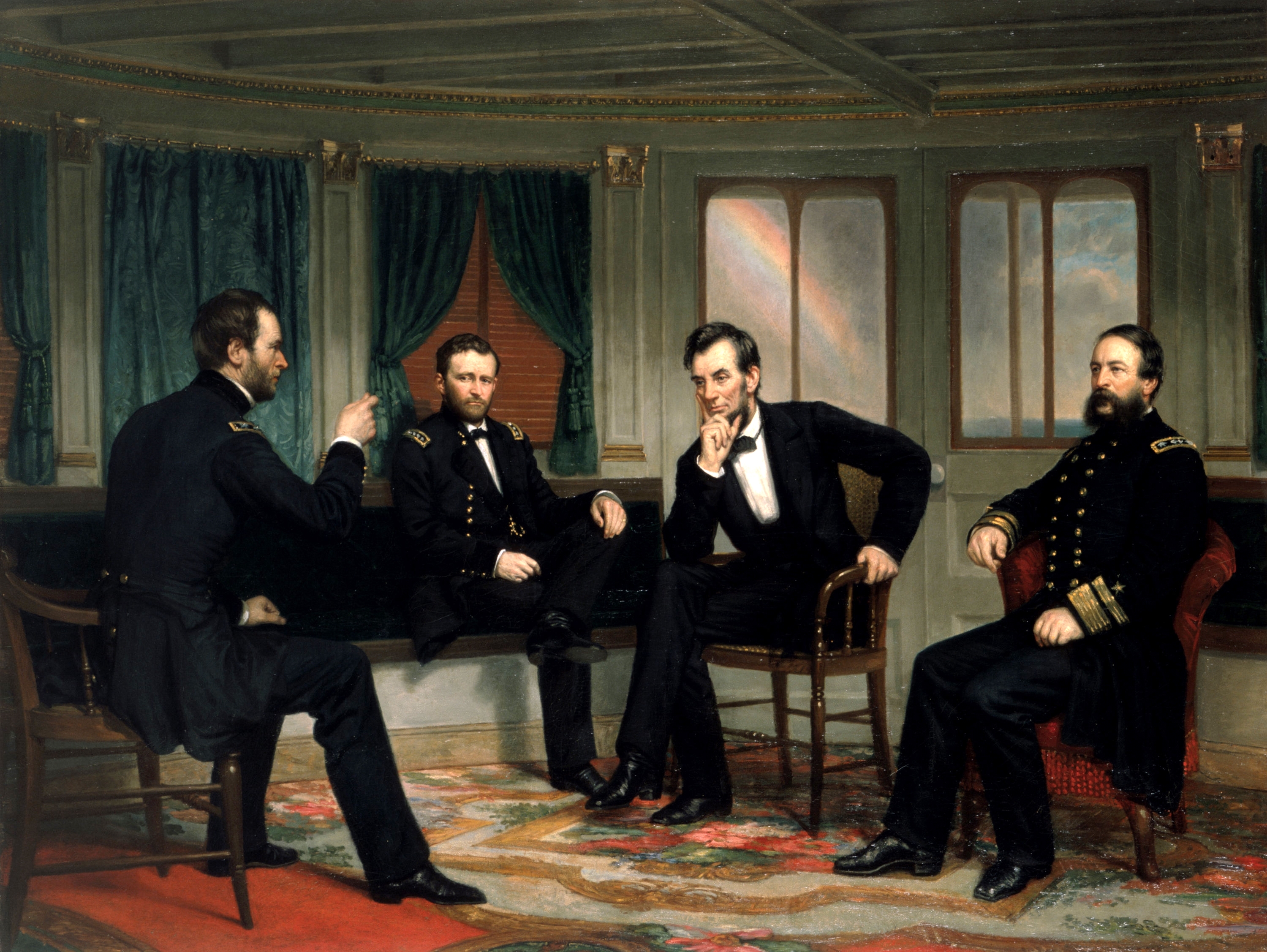
Casting That New Lincoln Biopic
| L to R: Sherman, Grant, Lincoln, Porter |
In Chicago about June or July of that year, when all the facts were fresh in my mind, I told them to George P. A. Healy, the artist, who was casting about for a subject for an historical painting, and he adopted this interview. Mr. Lincoln was then dead, but Healy had a portrait, which he himself had made at Springfield some five or six years before. With this portrait, some existing photographs, and the strong resemblance in form of [Leonard Swett], of Chicago, to Mr. Lincoln he made the picture of Mr. Lincoln seen in this group. For General Grant, Admiral Porter, and myself he had actual sittings, and I am satisfied the four portraits in this group of Healy's are the best extant. The original picture, life-size, is, 1 believe, now in Chicago, the property of Mr. [Ezra B. McCagg]; but Healy afterwards, in Rome, painted ten smaller copies, about eighteen by twenty-four inches, one of which I now have, and it is now within view. I think the likeness of Mr. Lincoln by far the best of the many I have seen elsewhere, and those of General Grant, Admiral Porter, and myself equally good and faithful. I think Admiral Porter gave Healy a written description of our relative positions in that interview, also the dimensions, shape, and furniture of the cabin of the "Ocean Queen" ; but the rainbow is Healy's—typical, of course, of the coming peace. In this picture I seem to be talking, the others attentively listening. Whether Healy made this combination from Admiral Porter's letter or not, I cannot say; but I thought that he caught the idea from what I told him had occurred when saying " that if Lee would only remain in Richmond till I could reach Burkesville we would have him between our thumb and fingers," suiting the action to the word. It matters little what Healy meant by his historic group, but it is certain that we four sat pretty much as represented, and were engaged in an important conversation during the forenoon of March 28, 1865, and that we parted never to meet again.
Aug 2, 2012
So I Haven't Blogged About History in a While...
Anyway, I recently found out that Yale has put a bunch of random lectures up on YouTube. You too can get a $200,000 education for the cost of an internet connection*!
I've been totally engrossed by this one professor's course on the American Revolution. Her name is Joanne Freeman, and, according to her Yale biography, "was rated one of the nation's "Top Young Historians" in 2005." Also, she's really funny. You should watch her lectures (first one embedded below)!
She seems to do a really great job of making the Revolution accessible, putting into the action, not as a modern-day patriot but as someone of the time who has no idea what the heck is going to happen.
*Degree, discussion sections, residence within campus housing, and access to libraries, student health insurance, or anything else that students get, not included.
Sep 29, 2011
Prohibition
That's why I can't wait for his new documentary, which will be showing on PBS starting this Sunday. It's on that great American experiment, Prohibition. So, go grab a tumbler, make yourself an Old Fashioned, and enjoy the featurette with great anticipation:
May 5, 2011
The Father of Imbibing
Everyone already knows that George Washington is the man, what with telling the truth about chopping down that cherry tree, defeating the British, being made of radiation, and killing zombies. Apparently, that's not all. Our nation's first president was also a connoisseur of that fine early malt tradition. In his "Notebook as a Virginia Colonel" in 1757, the crazy hooligan added a recipe for "small beer." Described as "roasty" and with an aura of "coffee," the founder's brew is easy to make, so long as you know when the temperature is "Blood warm."
Anyone up for some celebratory brewing? Start now and it might be ready by the Fourth of July.
The recipe:
To make Small Beer
Take a large Sifter full of Bran Hops to your Taste. - Boil these 3 hours. Then strain out 30 Gallons into a Cooler, put in 3 Gallons Molasses while the Beer is scalding hot or rather drain the molasses into the Cooler & strain the Beer on it while boiling Hot. Let this stand till it is little more than Blood warm. Then put in a quart of Yeast if the weather is very cold, cover it over with a Blanket & let it work in the Cooler 24 hours. Then put it into the Cask - leave the Bung openhole open till it is almost done working - Bottle it that day Week it was Brewed.
Last WWI Combat Vet Dies
Wow--it truly is the end of an era. The last combat veteran of World War I, Claude Choules, has died in Australia. How crazy, to see something like that happen. I remember an estimate that there were 65 million combatants in World War I. Someone had to be the last to survive. Mr. Choules was it.
Apr 12, 2011
Civil War Sesquicentennial
Today marks the 150th anniversary of the first shots of the American Civil War. On this day in 1861, Confederate forces began firing upon the Union-held Ft. Sumter at the mouth of Charleston Harbor.
Inside the fort was Maj. Robert Anderson, an artillery commander who had once taught at West Point.
Leading the bombardment was recently promoted General P.G.T. Beauregard, who had been taught artillery and been an assistant to a certain artillery officer named Robert Anderson.
Ft. Sumter stands as a fascinating start to a truly horrifying conflict. No casualties were suffered by either side in that entanglement. However, almost exactly four years later, the war would be over and 622,000 lives would have been lost.
In addition to that was the human element, exemplified by the relationship of the adversaries at Ft. Sumter. Over the course of the war, countless friends and families were ripped apart. Some of the famous examples include:
- Confederate Gen. Lewis Armistead sending his Bible to his dear friend Union Gen. Winfield Scott Hancock's wife (Armistead would die the next day while leading a portion of Pickett's Charge against Hancock's troops),
- Confederate Gen. James Longstreet serving as a groomsman at Union Gen. Ulysses S. Grant's wedding, and
- Confederate Gen. Jeb Stuart's father-in-law, Union Col. Philip Cooke, chasing him unsuccessfully as Stuart rode is cavalry in a circle around the entire Union army.
For these reasons--the combined horror and humanity, not to mention the central moral purpose of emancipation that President Lincoln successfully transitioned the war into--the Civil War is inscribed into our collective national memory. I hope that we continue to remember it, with both fascination and reverence, for its effects and its costs. As Robert E. Lee said during the massacre of the Battle of Fredericksburg, "It is well that war is so terrible, or we would grow too fond of it."
Mar 21, 2011
The Speech of the King

So, yeah, when it comes to movies, I am routinely months (if not years) behind the curve. That means that me having seen The King's Speech on Friday is nothing short of a miracle. It only won the Oscar for Best Picture like three weeks ago. That said, even though it's showing in about three theaters in the United States by this point, you should go see it.
April 1925 was a particularly bad experience for the Duke as he had become President of the Empire Exhibition and was required to make a speech which would be broadcast on radio and be made in front of his awe-inspiring father, the King. The King recorded that "Bertie got through his speech all right" but others noted that there were embarrassingly long pauses in it.
Feb 28, 2011
RIP Frank Buckles
As an aside, there are still two remaining World War I vets in the world. I imagine that in the next few years, they too will pass, and the world will keep on revolving, barely noting it.
Jan 20, 2011
Have You Seen The Google Today?
However, it is also the anniversary of (almost) every president's inauguration since the 1930's. So, below I post as many of the inaugurals that I could find on Youtube, beginning with the famous Kennedy address (and, as a side note, Eisenhower's and Reagan's second addresses were on Jan. 21 due to Jan. 20 falling on a Sunday):
Roosevelt 1937
Roosevelt 1941
Roosevelt 1945
Truman 1949
Eisenhower 1953
Eisenhower 1957
Johnson 1965 (not complete)
Nixon 1969
Nixon 1972
Carter 1976 (not complete)
Reagan 1981
Reagan 1985
Bush 1989
Clinton 1993
Clinton 1997
Bush 2001
Bush 2005 (I can't find a video or audio file of it...)
Obama 2009
Jan 10, 2011
Dick Winters, 1918-2011
Major Winters was a relative unknown until Stephen Ambrose's 1992 history of the WWII service of Company E ("Easy"), 2nd Battalion, 506th Parachute Infantry Regiment, 101st Airborne Division, entitled Band of Brothers. The story is one of those that has to be read to be believed. The men of Easy Company--and their comrades throughout the 101st--parachuted into Normandy in the wee morning hours of D-Day. They cleared the Germans from Normandy. They parachuted into Holland during Operation Market Garden. They were surrounded, yet held out, around the Belgian town of Bastogne during the Battle of the Bulge. They marched on, and took, Berchtesgaden--Adolf Hitler's summer retreat. They helped liberate concentration camps.
And then those survived came home. Some went to college, while others went to work. They married, had children, bought homes, and continued life, like all our World War II veterans, unsung and dignified. Major Winters, after winning the Distinguished Service Cross for his actions in Normandy, and after having led Easy Company for much of the war, went back to his home in Pennsylvania, where he eventually settled down on a quiet plot of land to live his life. Even today, his actions for taking out a number of German 88mm cannons behind enemy lines on D-Day are taught at West Point as ideal on-the-ground tactics.
Winters, from all that I've seen and read of him, was quiet, sharp, and self-effacing. He spent much of his life extolling his comrades-in-arms. I'm sorry he's gone. The world--quite literally--is better because of him, and ultimately, as a legacy, what more could one ask for?
Nov 22, 2010
Remembering The Iron Lady
Oct 15, 2010
The Oval Office
Presidents, of course, are all different, and one way their individual differences, political and personal, manifest themselves is through a change in decoration of the Oval Office. It's a tradition that has happened since the Oval Office came into being. When George W. Bush came into office in January 2001, he had the Clinton rug removed and replaced with the old Reagan rug, symbolically indicating in whose footsteps he wanted to follow. In contrast, when Barack Obama became president, he kept George W. Bush's decorations for almost two years, not to indicate a continuity of policy but to avoid a display of needless extravagance in the midst of a recession. How the decorations are treated means something, both to the president and to the American people.
Its decor is also subject to unintentional symbolism. For example, while John F. Kennedy was traveling to Dallas in November 1963, the Oval Office was redecorated with a deep scarlet rug and new furniture. He never lived to see the change (in fact, Mrs. Kennedy never saw it either; the decorations were taken down immediately after the assassination, before she returned to the White House), and Lyndon Johnson, soon after his assumption of the presidency, went back to the dull Truman-era green. The optimism to take on everything--even the traditional old Oval Office--that had seemed so bright was extinguished.
Gerald Ford, upon Nixon's resignation, had the Oval Office redecorated, not as much because he disliked the look as to indicate a severance between his administration and his predecessor's. The eagle carpet was removed, replaced with a nice pale yellow, patterned rug. Jimmy Carter kept the decorations during his administration, though he rearranged the furniture a bit.
Ronald Reagan on his last day in office
Replica of Reagan Oval Office (at Reagan Library)
Reagan was, of course, followed by the first George Bush, who changed the colors of the office to a sky-blue motif. As far as my aesthetic is concerned, it's pretty atrocious, but whatever.
George Bush Oval Office (note the Reagan couches are the same)
Then came Bill Clinton. Frankly, of the motifs I've seen, I like his the best. He used a bold blue rug and two couches with alternating red and white stripes of varying thicknesses. To me, it reflects both the power of the office by catching your eye and subconsciously reflecting the American flag.
Clinton Oval Office
His office was effectively recreated for the television drama The West Wing, which was written as an alternate history to the Clinton presidency. What if, it posits, the president were intelligent like Clinton but had a better moral compass? It's a great show, which, while (according to former White House staffers) not being entirely accurate on the White House layout or the way policy is done, is an excellent portrayal of the energy and the 'mood' that an administration exudes.George W. Bush, as mentioned above, had the Reagan rug pulled out of storage very soon after he took office. During his tenure, the Oval Office floor was redone (in a beautiful light/dark alternating wood pattern), and his new decorations were put in. They were less intense than the Clinton colors, though I must admit his 'sun rays' rug was an incredible touch. He gets the silver medal in Josh's contest.
Bush meeting with advisers in 2001
The Obama Oval Office
One thing is sure: as long as there is a presidency, there will now be an Oval Office. Our nation's psyche is attached to it. Were something terrible to happen to the White House and the Oval be destroyed, it would be immediately rebuilt. It stands for the Office of the President more than any individual ever could.
Almost all pictures courtesy of the White House Museum (check them out!)
Oct 9, 2010
Secretariat
The film Secretariat, based on the life of the horse who made ESPN's top 100 athletes of the century list (at #35), came out this weekend. I haven't seen it yet, but I'd very much like to. Slate has a great article discussing why people are able to get so wrapped up in Secretariat's story. Why do we--even today, almost almost forty years after the events took place--love the big, lazy, champion? Unlike Seabiscuit, who was tiny and always the racing underdog against the big-boys, Secretariat was always the champion. He was like the guys on my swim team in high school who would skip practice for days on end but still win their events at the meets. You couldn't help but be impressed by their athleticism.
I first learned about Secretariat from my dad's old business partner, who used to come to our house every day to work. She'd leave Lemonheads for my brother and me and would also leave the scent of perfume wafting about our house, since she would pet the cat all day and transfer all the smell to her. She also loved horse racing. One day, she brought a huge coffee table book about Secretariat to our house. I gobbled it up and then went on to tell anyone who would listen the story of the horse. Go figure, most third graders didn't particularly care about how he won the Belmont by over 30 lengths or how his heart was twice as big as a normal thoroughbred's. Whatever. I thought it was cool.
Oct 4, 2010
The Crazy History of Blue
Such is the story of blue!
Anyone familiar with high school chemistry knows of copper ions' bluish tinge, so it makes sense that the chemical pigments would have that ion hanging about (see the 'Cu' in the formula). Mayan blue, however, was a bit more cagey. Even today scientist's aren't sure exactly what they used, though they believe it was a mixture of naturally occurring indigo plants and a clay called palygorskite. Though different in their makeup, each of the compounds has lasted for centuries: you can still see blue paint on Egyptian friezes and sculptures, ancient Chinese porcelain, and Mayan sacrificial sites. That's right: in times of drought, in order to bring the 'blue' rain, Mayans would cover someone in the blue dye and toss them into a sacrificial well. Even today, there are wells found with over ten feet of hardened blue dye on the bottom.
As an unintended side-effect of Prussian blue's discovery, by the 1800's, lapis lazuli, the blue stone that had been so precious to medieval and Renaissance aristocrats, was shunted aside. If anyone could have blue, they figured, why would they even bother?
Even today new blues are being synthesized, continuing a chain from ancient times to now.
Sep 10, 2010
Kermit and the Smithsonian
Apparently, about two weeks ago, the original Kermit the Frog, made by Jim Henson out of a green coat (and not yet really a frog), was donated by Jim's widow, Jane, to the Smithsonian, along with a few other puppets from the early Sam and Friends days. What a wonderful thing for Mrs. Henson to have done! I can't wait to see how they display them all.
Below is a great skit with Kermit from the good ol' days, followed by a montage of Wilkins and Wontkins commercials--classically Henson, full of unapologetic assault, violence, and maiming.
Sep 8, 2010
Aug 23, 2010
It's Nice to Know Someone Still Appreciates the Golden Girls
Alas, of the original girls, only Betty White survives (and hosts SNL!). However, as a fitting tribute, artist Ginger Williams has memorialized our favorite retirettes in the form of nesting dolls:

h/t Super Punch