Showing posts with label math. Show all posts

Jul 6, 2011

I'm Back, With Math Jokes

Hello, blogosphere. I haven't seen you in a while. I've been cavorting around these United States for the past few weeks. Maybe I'll update on that, if I remember/have time? The first post after a while is always awkward, because you feel like you need to write something totally epic.

I'm not even going to try.

Instead, I will post an email chain that I exchanged with a friend of mine:

From: [Friend]
To: [Me]
Subject: I want your address

You will hand it over or I will send a waveform of hyperbolic ninjas at you.
______________________________

From: [Me]
To: [Friend]
Subject: Re: I want your address. OK!

I have one house in the real plane (\mathbb{R}^3) and one on the Riemann Sphere, but the directions to that one might be a little complex.

The real-valued address is:

Grand Marquis Joshua Sauerman KG, GCMG, LVO, KStJ
[address withheld]

Oh, wait. That's the imaginary-valued name. The real one should just read "Josh Sauerman". I'd lose my head if it weren't screwed on.
______________________________

From: [Friend]
To: [Me]
Subject: Re: I want your address. OK!

Thank you, Grand Marquis Sauerman.

You are too funny, let's be friends. Some people collect bottle caps. I collect bipedal humor spigots.
______________________________

From: [Me]
To: [Friend]
Subject: Re: I want your address. OK!

Friends it is! Keep me around and your spigot will gush forth milk and honey at a rate of  v = - \frac{1}{4 \eta} \frac{\Delta P}{\Delta x} (R^2 - r^2) .

______________________________

From: [Friend]
To: [Me]
Subject: Re: I want your address. OK!

You make me want to remember how math works.

Jul 21, 2010

SIGGRAPH 2010!

Starting next week is the every-year-much-anticipated SIGGRAPH (Special Interest Group on GRAPHics and Interactive Techniques) conference on computer graphics. Since all the technical papers involve math, and since I like math, I downloaded some.

Yeah. About that. I haven't done cool math in three years now, so I get about two pages in before being confused. Curses.

However, SIGGRAPH is known for being the place where people display awesome new stuff, like this:

Lagoa Multiphysics 1.0 - Teaser from Thiago Costa on Vimeo.


Unfortunately, I will be across the pond during the event, so I won't be attending. Hopefully next year.

Anyway, it's worth checking out all the submissions. Cutting edge technology is so groovy!

Mar 14, 2010

Happy Pi Day!

Sorry; I haven't been posting lately, but no matter. It's Pi Day!

Dec 31, 2009

2009, and the Year to Come

The New Year has always seemed a bit anticlimactic to me. At midnight, everything is pretty much the same as it was before: my job hasn't changed, the weather hasn't changed, my foibles haven't changed. The move from Dec. 31-Jan. 1 is little different than the change from Jan. 31-Feb. 1, Feb. 28 (9th...ooooh)-March 1, etc. However, I think it's a great idea to 'start anew' every once in a while, and Jan. 1 seems as good a time to me as any. This, in the public mind, marks the end of the 00's (actually, 2011 is the end, but whatever). When they began, I was an eighth grader, having just survived an epic battle with E-coli that (I learned later) almost killed me. Y2K was the big worry of the hour. I remember standing in my aunt and uncle's kitchen, watching the ball drop, and thinking "In 2010, I'm going to be 23 years old!"

Well, here I am, and here we are. 10 years older, two presidents (and two wars) later, hair growing on my face, high school and college degrees received, employment attained. Seems strange that 2000 feels like it was so recent. I guess that's what my grandpa is referring to when he discusses how sometimes he feels like he should still be in the 1940's.

Your 20's are supposed to be quite a time in your life. I suppose mine will be, too (though I have a three-year head start already). I welcome 2010 and the next ten years with anticipation. So, tonight, we celebrate. Tomorrow, we pave hell with our resolutions (as Mark Twain so gently put it). Today, however, I leave you with this, courtesy of John Derbyshire:

Someone wants to know if there is anything interesting to say about the number 2010.

Nothing occurs immediately. 2010 has no entry in David Wells's indispensable Dictionary of Curious and Interesting Numbers. Nor could I find a reference in Conway & Guy on a quick leaf-through.

It's a rounder-than-usual number, having sixteen factors, the usual number of factors for numbers of that size being about 4. (Note: the "usual" number of factors of a number in the region of n is (log n)log 2 — natural logs, please — which for n = 2010 comes to 4.081. See Hardy & Wright, The Theory of Numbers, §22.13.)

The OEIS turns up 154 entries for 2010, but none of them really made me jump out of my chair. It's nice that 2010 is the 16th 21-gonal number, and the 35th coefficient of the 6th-order mock theta function ρ(q), and the number of trees of diameter 7 (huh?), and belongs to the happy band of numbers which are the products of distinct substrings of themselves (2010 = 201 × 10, see?). I'm even willing to give a nod of appreciation to the fact that 20103 / 3 is the average of a pair of twin primes. On the whole, though, one is left contemplating the great universal truth that something has to happen, and that there is no number so benighted that there isn't something mildly noteworthy to say about it. (This latter fact can be proved rigorously.) We are all special!

Jul 18, 2009

How to Take Over the World

There's a new mathematical model (which this article only mentions; it is thirsting for detail) that has been developed that gives clues to how a small group of people can lead a large group to a desired result. Basically, leaders, all striving toward the same goal, need to be sufficiently dispersed amongst the populace so to lead smaller groups into one large, cohesive whole.

It's interesting that there is now a model for it, since we've been doing it for hundreds of years. It's called a political party.

Jan 3, 2009

How to Make a Puppet Pattern, Part III

I was told that it would be a good idea to show an example of me doing this. That is a good idea, so here it is. I'm working on a triceratops puppet now, and I needed to make a body. Ergo, I made an ellipsoid.

Beware--I was making a pattern on a piece of black posterboard (it's all I had) with pencil to make it show up. Hopefully it's not too painful to see.

I determined that the height would be 6 inches (making a=3) and that the width would be 4 inches (making b=2). Following the formulas in this post, I found the height and width of the pattern.


I drew an extended line to the left. Somewhere on that line is the center of the circle that will have a radius making both the top and bottom of the height line and the far right point of the width line all points in the same arc.


I copied the angle on the left and mirrored it on the right. You can see where the two arcs intersect. I drew a line from the top of the height (the longer one; this picture has been rotated 90 degrees), through the intersection of the arcs, all the way to the dotted line. This formed the isosceles triangle that was needed.


Using the line that I just drew, I took a string and a pencil and created an arc, connecting the three points that I needed. Because of my 'simple' compass, the line wasn't nearly as smooth as I would have liked, but it'll work.


I recreated the same arc on the other side, leaving me with a pre-cut pattern.


The pattern after cutting.


I copied it eight times onto the foam.


I then cut out the pieces. The foam had been in my closet for a little while, so it was slightly curved, which actually worked to my advantage later.


I coated the sides of the pieces with contact cement and then began sticking them together. Here, you can see it halfway done.


The ellipsoid, halfway done.


The inside, halfway done.


I finished it off, resulting in this: the final product.


It worked perfectly. I cut off the top and part of the bottom to make the holes for my hand (since this will be the body of my puppet).

So that's how it works in reality, not just in theory.

Dec 19, 2008

How to Make a Puppet Pattern, Part II

The Ellipsoid

Go to Part I if you want to see how to make a sphere. Now, we're going to make an ellipsoid. The formulas are more difficult, but overall, the process is almost identical.

I worked this up last night in my apartment. The circumference (or perimeter--whatever you want to call it) of an ellipse is a really crazy formula:
where (denoted in the C equation as ) is the eccentricity of the ellipse.

"Whoa!" you say. "What are these a's and b's you're talking about?"

Well, my dear friend. Look to the left. You can see in my little drawing that I have denoted both a and b. We are going to make this figure, which is a 'prolate' spheroid (a 'stretched' sphere). The darker edge is one half of the ellipse (oriented vertically). Can you see that b is the radius of a circle in the middle? Good. Now, what do those mean?

a is half of the ultimate height of your spheroid (A is the total height). So, if I want my puppet's spheroid head to be 1.5 feet tall, then a is 1.5/2 = 0.75 feet. b is half of the width of the spheroid (B is the total width; the diameter of the central circle).

That equation above, though, is ridiculous. No one wants to spend the time solving for eccentricity. That is where Srinivasa Ramanujan comes in. He estimated (way more accurately than we care to be) that the perimeter of an ellipse is roughly:
.
That is (though it may not appear so) way easier than the real formula. Look at that picture above again. See the dark curve marked C/2? That, you can see, will be the height of our pattern. That amount is simply half of the circumference, which means it is roughly the amount to the right: [4.5(a+b) - 1.5*sqrt((3a+b)(a+3b))]. That is by far the most difficult part of this process.

The width of each piece will, like the sphere, be one-eighth (1/8) the circumference of the center circle. Remember that b is the radius of the center circle? That means the circumference is 2πb. Estimate that π is 3, and we get roughly 6b. Now divide that by eight, and we get .75b, as you can see in the formula to the left.

Now, you simply need to follow the instructions for the sphere. Choose your height-- A=2a, your width-- B=2b for the final product. Now, draw a vertical line equal to 4.5(a+b) - 1.5*sqrt((3a+b)(a+3b)). Through the midpoint of that line, draw a horizontal line equal to .75b. Now, copy the angle made by connecting the end of the horizontal line to the end of the vertical line (M), to make angle N. Make an isoceles triangle (as you can see to the right), and use its tip as a center for your compass to creat a curve connecting the top of the vertical line, the right end of the horizontal line, and the bottom of the vertical line.
Do that again on the other side, and you get a figure that looks like this.
Just to demonstrate that the equation really isn't that hard, take my example from before. Say that I want my height to be 1.5 feet and my width to be 1 foot. Using the formula, we discover that the height is simply 2.27 feet and the width is .375 feet. I can now follow the rest of the instructions, cut out eight foam pieces, and creat my ellipsoid!
So--that's how you make a puppet pattern for a sphere or an ellipsoid. I know that it may not make complete sense. Please feel free to write questions in the comment field, and I'll be happy to answer them ASAP


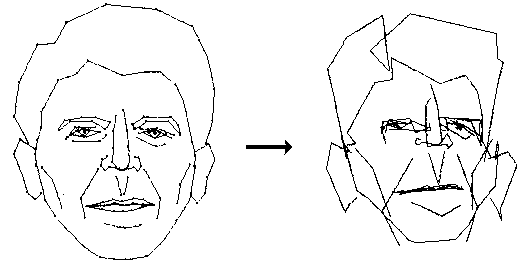
Mathematical Caricatures?

I was looking for a good photo of Ronald Reagan to caricature (he's so wrinkly...), and I came across this amazing article. It's about topology and how continuous deformations of objects can yield recognizable, though drasitcally different mirror-objects. The question asked (and never answered by the article) is: why is it that we recognize a cartoon of a certain person as that person. How is it that all the cartoons about George W. Bush are clearly about him, even when the White House and other context-driven clues are removed? It also asks why people can recognize someone with only a tiny piece of the face--the eyes, the hair, the nose, the mouth, etc.


Most caricatures are not done by mathematic means but by emphasizing already prominent features (while maintaining space relationships between different facial planes). What does that mean? Cartoonists are effectively using biological topology every day. Why do pictures that emphasize George Bush's hair not look like him while those that emphasize Rod Blagojevich's do? Why are Jimmy Carter's lips always big, while Richard Nixon's nose is always long? These are the identifying characteristics, and, I would posit, they are the planes that most strongly depart from the ideal face of beauty, be they bigger, smaller, wider, thinner, or whatever.

Dec 9, 2008

How to Make a Puppet Pattern, Part 1

OK, so I'm a complete amateur, working on my first puppets right now. I am, however, a mathematician (or I pretend to be). I recently realized that I needed to make a body for my puppet. I wanted to make a football shape, but I didn't want to fork up the cash for a Project Puppet design. I decided to do some math to find out how to turn a 2-d surface (namely, foam) into a 3-d shape (namely, an ellipsoid). What follows is how I went about it. Be forewarned that there will be math and formulas, which may be boring to all one of you that will read this post. I'll start with a sphere and then move on to the prolate and oblate spheroids (stretched sphere, squashed sphere).

If you don't want to read the process, just go to the end of the post, and you will find simple directions on how to make a pattern.

Sphere

Take a look at my handy picture. You will see that in a sphere the distance from the center to the surface on all three axes (X, Y, Z or length, width, and height) is the same. I've labelled it R (for 'radius', since I'm clever). R will make our calculations very convenient, as you will see if you make it to the spheroids.


When we make a sphere out of foam, we will need to focus on the surface. (since it will be hollow). We will cut it into kayak-shaped pieces, just like the longitude lines on a globe (see picture to the left). I will use eight pieces (though you can easily to more, and less easily do less; I wouldn't recommend less than five or six).

How will we figure out the measurements for these pieces?

First, consider how tall you want to make your sphere. How big will the puppet's head or body be? That length is the length from the top to the bottom of the sphere, which, as you can easily see, is 2R. This allows you to figure out R (by dividing the length you want by 2).

Now, have you ever noticed that if you cut a sphere in half along any of the axes (X,Y, or Z), the circle that you get is the exact same size? That's important here. We're going to cut the sphere along the X axis (with an X/Z plane). We get a circle (which I've highlighted in blue). You can see that the height of our sphere piece will be half the circumference of that circle.


That's handy for us. The circle has a radius of R, which means that it has a circumference of 2πR (see here for that formula). We want half of that, which is πR. This will be the height of our piece. I have drawn it out in the picture to the left.


What will the width be, you ask? Great question! I am making this out of eight pieces, which means that the width of each piece should be one-eighth (1/8) of the entire length of the sphere's equator. Note that if you are making it out of more or fewer pieces, the fraction will reflect the number of pieces you are making (so, ten pieces, 1/10; four pieces, 1/4). Because this is a sphere, once again, the length of the sphere's equator is equal to 2πR, which means that the length of our piece will be 2πR/8 = πR/4. This is important. It means that the width of our pattern will be one-fourth (1/4) the height. Since a sphere is symmetric in all directions when cut through the center, the width and the height will bisect each other. I've drawn it out to the left. Oh, and don't worry about π right now. We're just going to estimate it as 3 at the end.


Well, this is great. We have the height and the width. we have just one more problem. The sides must be curved, since the sphere itself is curved on its surface. We need to figure out how to connect the endpoints of the width and the height. See figure to the left.


To find this curve is surprisingly simple. We need a circle that has a center on the same axis as our width (the short line). The distance from that center to the end of our width line (the radius of that circle) must be the same as distance from the center of that circle to the top and the bottom of the height line. How can we do this? We need an isoceles triangle, with the two equal sides going from the far end of our width line and from the top of the height line to the center of that circle. Using a compass and straightedge, it's not too hard. Just copy angle M (see picture) to become angle N.


Now, using the compass, make a curve from the bottom of the height line to the top of the height line. Copy that to the other side, and you have your pattern. Make eight of these out of sheet foam, and, presto! you have a sphere.


Check in soon to see how to make a spheroid.