Dec 17, 2012

St. Bernard Sketches

Here are a few St. Bernard character drawings I did today:


What a great breed of dog!

Dec 14, 2012

Lost Letters of the Alphabet (and Other Weird Letters, Too!)

Have you ever wondered why we have some letters in our alphabet but not others, or why certain letters were lost in the transition from Greek to Roman to English?  Or, did you not even realize that there were other letters out there?  Either way, I'm here to help, with this handy guide to the lost letters of English.

Take this bit of literature, for example:

Hwæt! We Gardena          in geardagum,
þeodcyninga,          þrym gefrunon,
hu ða æþelingas          ellen fremedon.
Oft Scyld Scefing          sceaþena þreatum,


If you recognize that as the the beginning of the epic Old English poem Beowulf, you get ten points.*

Now try to read it out loud.  It's hard, right?  How does one pronounce "hu ða æþelingas"? (The answer is "hoo tha ethelinguhs").  We have a hard time understanding it because we've lost three of the letters in this passage: æ, þ, and ð.  Of course, there are even more than that!  Read on if you'd like to know what they are!

Well, let's start with those three I just mentioned.


Æ, æ

As you may have guessed already, Æ is basically the letters A and E pushed together into one.  Linguistically, it's called a 'ligature'.  For the Romans, this was just a handy way to save some space.  For Old English (and still today in some Northern European languages), it's a letter unto itself.  That letter is called 'æsch' (meaning 'ash' as in the type of tree), and it's generally pronounced somewhere between an A and E.  Common words that once used it are 'ether' (æther) or 'medieval' (mediæval).

Þ, þ

This letter is called 'thorn' (or 'þorn') and it's one of my favorites.  Originally part of the ancient runic alphabet, it basically filled the gap that had been left when Latin adapted the Greek alphabet and dropped theta, the 'th' sound.  Thorn is found regularly throughout Old and Middle English manuscripts, largely because so many of our modern articles and pronouns used to have it (the, this, that, those, these).  Thorn still appears today at renaissance fairs, where we see stores saying "Ye Olde Whatever".  The reason they say that is because lowercase thorn and lowercase Y looked so similar (EME ye.svg - doesn't that look like a lowercase Y?). So "Ye Olde Whatever" would've actually been pronounced "The Olde Whatever".  Thorn stopped being used sometime in the 1400s, with vestigial use in the early versions of the King James Bible (in the early 1600s, where it was written as 'ye', but understood to be pronounced as 'the').  Thorn is still used in Icelandic.

Ðð

This is called eth, and in Old English, it was pretty much interchangeable with thorn (sometimes you'll even see the same word in the same document interchanging the two throughout).  In modern Icelandic, it is more associated with the 'th' sound in mother or the or these, while thorn is used for the 'th' in words like (surprise) thorn or thistle.  Eth disappeared early in the Middle English period (around 1200-1300).

Now, here are a few others you may have seen or heard of:


Œœ

Often called 'ethel' or 'œthel', this letter is similar to æsch and is still in use in British English and French, though rarely in American English. It is usually pronounced as a short or long E.  Words that used it include fœderal ('federal'), subpœna ('subpoena'), or diarrhœa ('diarrhea').


Ƿ, ƿ

Although it looks a lot like thorn, this letter is actually 'wynn', used in Old and Middle English until around 1300 AD.  The letter itself was originally a rune (like thorn; those two letters are the only two that are derived from runes), but was brought into Old English to replace what had previously been written as 'uu' (surprise--it's a double-u, or W).  It was, for a short time, modified in Old Norse into the letter 'vend' below:


Ironically, even though wynn replaced 'uu', it was itself replaced by non other than the double-u.

Ȝ, ȝ

This is the letter yoȝ (or 'yogh').  It appeared in English during the Middle English period, being borrowed from the Gaelic languages.  It was generally pronounced as 'ch', as in 'loch', though sometimes acted as a Y or W.  In most cases it actually replaced the letter G, which had been used in Old English but sometimes pronounced as G and sometimes as Y (for example, in the Beowulf passage above, the word geardagum would be pronounced "yar-dagoom").  It disappeared during the Middle English period.  One word that used to be spelled with yogh, before dropping it completely?  ȝif ("if").

ſ

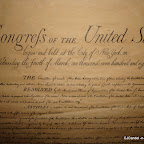
If you are an American or a math student (or both), you have almost certainly seen this letter, even if you didn't realize it.  It's called a 'long s', and basically, it's a stylistic use of the letter S, indistinguishable in pronunciation.   It appears, most notably for Americans, in the U.S. Bill of Rights, where it looks like the word is "Congrefs":


The long s had been in use since Roman times, usually appearing whenever there was a lowercase S at the beginning or in the middle of a word.  It had almost fully disappeared from English by the first decade or two of the 19th century.  It does remain, however, in mathematical notation, as the sign of an integral in calculus (integral originally being called a 'ſumma'):


It's still pretty weird looking, though.

&

Ampersand is a weird letter/symbol, because it has been used as both in its history.  The name comes from the way the alphabet was formerly written, with & coming after Z.  When you would finish your alphabet, you would say "...X, Y, Z, and, per se, &" (per se meaning "on its own", pointing out that ampersand stands alone, not as a letter within a word--you wouldn't go off and eat some yummy c&y for Halloween).  Eventually "and, per se, and" became "ampersand".  The letter, as you probably know, represents the word "and", though is derived from the Latin "et" (meaning, of course, "and"):


Ŋŋ

This letter, called "eng" was barely used outside of phonetic alphabets.  It was developed in 1619 to replace the English "ng" (or, should I say, "Eŋlish"), but never really caught on.  Ben Franklin liked it, though.  It is used in many foreign alphabets.


Ȣȣ

This letter, which doesn't have a name that I can find, is a ligature of Greek omicron (O) and upsilon (Y).  it was never used in English, but it appears somewhat often in Byzantine religious icons.  It also appeared in Algonquin alphabets, though has been largely replaced by W.


The Claudian Letters

Ↄ, Ⅎ, 

These are my favorite letters that weren't, called "The Claudian Letters" after the Roman Emperor Claudius, who promulgated them when he ascended to the throne.  Suetonius writes:


Besides this he [Claudius] invented three new letters and added them to the alphabet, maintaining that they were greatly needed; he published a book on their theory when he was still in private life, and when he became emperor had no difficulty in bringing about their general use. These characters may still be seen in numerous books, in the daily gazette, and in inscriptions on public buildings.

Each letter serves a distinct purpose, trying to fill holes in the Latin language:

  • would replace BS and PS.  A similar phonetic replacement had happened earlier with GS and CS being replaced by X (something we still do today).
  • would act as a consonant V, representing our modern V or W sounds (Latin only had V, which represented our modern U, V, and W).
  • is a stranger one, filling the void, basically, of the Greek letter upsilon (Y).  While the distinction isn't particularly notable in modern English, it would've been a vowel somewhere between our modern U and I.

As with many reforms, these died out with Claudius.  Very few Roman inscriptions ever used them.  Good try, though!

In conclusion...

There are, naturally, many more letters (and alphabets, and systems of writing) out there, but these are examples of some that English and Latin have lost over the years.  Interesting, no?


* If you recognize that the translation is roughly: "Lo!** We Spear-Danes in days of yore, of people-kings, glory have heard, how those princes did valorous acts.  Often Scyld son of Scef from enemy troops, ..." you get ten more points.
** If you disagree with my translation of hwæt, preferring "What!" or "Listen!" you win the game automatically.

Dec 13, 2012

The Christmas Story As Told By New Zealand Schoolchildren

This video is so wonderful and sweet and hilarious and appropriate at this time of the year.

Dec 5, 2012

Happy 21st Amendment Day!

On this day in 1933, Ohio, Utah, and Pennsylvania ratifying conventions became the final states needed to secure the passage of the 21st Amendment, repealing the disastrous 18th Amendment and Prohibition.


So go get a drink and celebrate the fact that you can!

Dec 4, 2012

A Little Shameless Self-Promotion

So, this past weekend, I decided to set up a little shop for prints of my drawings on Etsy.  I'm not a big one on self promotion, but, oh well.  You should click on the link below and check it out!


Dec 3, 2012

An Elephant and a Rhino Walk into the Savanna...

Sounds like it could be a great joke, right?  But it's not.  It's just two pictures I did over the past few days, one of an elephant, and one of a rhinoceros.

I just love drawing animals.


Dec 1, 2012

Harvey Mansfield and Americanization, Europeanization, and Whatever...Also a Picture of a Little Girl Riding a Dinosaur

The Wall Street Journal today has an interesting weekend interview called "The Crisis in American Self-Government" with Harvey Mansfield, a government/political science professor at Harvard.  He's well known for giving students their 'official' inflated grades and their 'unofficial' grades that he would give them if Harvard had no grade inflation.  So, he hands out unofficial C-minuses like candy.

"This blog deserves a gentleman's C-"

Mansfield is kind of a token conservative voice at Harvard.  He's also their token defender of the classical Western canon of thought (Greek philosophy, Christian lit, Enlightenment writings).

I wrote a few years ago about meeting Prof. Mansfield while I was a college student:

Flash forward to college. I had but recently turned 21, and I was attending a dinner at the Quad Club at the University of Chicago, in honor of Harvey Mansfield and his book Manliness (I know, right?). The Quad Club is pretty swank, and, naturally, there was but one choice of beverage besides water: wine....I spent the dinner talking with a professor of mine and listening to the Committee on Social Thought debate...and drinking wine. I have no idea what the conversation was about; I remember wanting to know more about wine.

Looking back again, I do remember a bit about the tenor of the conversation, though not much of its substance. Mansfield was there at the invitation of Nathan Tarcov (and others, presumably).  He seemed as though he wanted nothing more than to enjoy some company and a meal.  All the University of Chicago people clearly wanted to have a symposium on Manliness.  Talk about a subject that gets people up in arms!  Like a sad pincushion, Mansfield eventually resigned himself to taking their barbs and answering their questions.

One thing that struck me then and strikes me now in his arguments is the "self-government of the soul."  That is, the notion that, for a democratic system to function, the people must act as checks on themselves.  Not in concert, mind you, but within themselves.  The individuals within a body politick must be enlightened and wise, so their votes are not cast on mere whim (who is most handsome, who said something that you thought was funny), but on a serious understanding of the arguments being made and choice voters face.  Democracy depends on the people not being drones or morons.  Mansfield's argument is that

[w]e have to take measures to teach the poor and vulnerable to become a little more independent and to prize independence, and not just live for a government check. That means self-government within each self, and where are you going to get that except with morality, responsibility and religion.

Besides the notion of people simply living for a government check (which some do, I'm sure, but not all; it's a bit of a cop-out to addressing more substantive issues on those voters' minds), I think he leaves out 'education' in that list, which is a quintessential need for understanding government and its role on society.  But these are things, whether you like them or not, that a system like ours must have to survive.  He thinks that the American, constitutional, amendable rule-of-law system is being overtaken by a quasi-European, cultural, unchangeable welfare state mentality.  Basically, that a constitutional system is changeable based on people's preferences, but an entrenched entitlement system is not changeable.  It doesn't seem to address, however, the issue of people wanting the entitlement system.  Maybe it's not changeable because people like it?

But I guess that's his argument against government checks.  It's that, when given money by the government, people lose a bit of that self-governing within, because the external impetus of cash overwhelms the internal sense of responsibility and independence.  Hmm.  Sounds like that famous sentiment attributed to Ben Franklin or Alexis de Toqueville or some guy named Alexander Fraser Tytler:

A democracy cannot exist as a permanent form of government. It can only exist until the majority discovers it can vote itself largess out of the public treasury. After that, the majority always votes for the candidate promising the most benefits with the result the democracy collapses because of the loose fiscal policy ensuing, always to be followed by a dictatorship, then a monarchy.

Mansfield also believes that there is a difference between American and European students; that Americans are trained by their families and the culture of the States to be ambitious and to think big, while the European system trains students to think small, stunting their ambitions.  Now, I don't know how much of that is simply American hubris coming through, but I can see a bit of truth to it.  The American culture is a far more liberal one, in a classical sense.  The average American worker will change professions (not just jobs, but professions) something like six times.  We have an interdisciplinary notion of work, where many things connect, many things help qualify us for other careers, and ideas in use in one industry regularly cross over to others.  The European model, where you train for a single career from the time you're in secondary school, is far more rigid, and therefore, presumably, far less open to change and creativity.  Of course, I have no experience with the European system.  Maybe I'm just full of American hubris too.

Because all that is very heady and it's a Saturday, I'll take a step back from the academy now.  Here's a picture I drew yesterday of a little girl dreaming about riding a T-Rex:


Nov 30, 2012

Rhinoceroses!

I'm just on a roll lately.  Yesterday I finished my lineup of eight bears.  Today I finished my lineup of five rhinos!  Rhinos are totally fascinating and totally weird.  Also, almost all of the species are about to go extinct, which is really sad.

But, again, before the drawings, her are some facts about rhinos:
  • The name, "rhinoceros" comes from the Greek ῥῑνόκερως, meaning (go figure) nose-horn.
  • The closest relatives of rhinos are tapirs and horses.
  • The woolly rhino, one of the last of the great ice age megafauna, probably survived until around 8,000 years ago.  When it died out, humans had just started to get the hang of agriculture.
  • Rhino horns are made, not of ivory or bone, but of keratin, the same material as your hair and fingernails.
  • The first rhino to be seen in Europe since ancient times went on tour in 1515.  It died in a shipwreck at sea while being transported to its next stop, but not before being sketched for posterity.  It took over two hundred more years for another rhinoceros to make it there.

And, so, here's the lineup of the five extant species of rhinoceros:

Indian Rhinoceros

The Indian, or "Great One-Horned", Rhinoceros lives in (surprise!) India.  It and the white rhino vie for the top spot as the biggest species.  It is the second largest species in Asia, behind the Asian elephant.  It is notable for its skin folds, which look like armor.  It's estimated that around 1910 there were only around 100 left in the world.  There are now around 3,000.


Javan Rhinoceros

The Javan Rhinoceros (or "Lesser One-Horned Rhino") once lived throughout the large Indonesian islands and southeast Asia, but it is now the rarest large mammal in the world, with an estimated population of only around forty individuals.  It is part of the same genus as the Indian rhino and looks very similar, though it is quite a bit smaller.  There were formerly three distinct subspecies, but the Indian population died off in the 1920s, and the last of the Vietnamese population was killed by a poacher in 2010.


Sumatran Rhinoceros

The Sumatran Rhinoceros is the most distinct of the five species.  It is by far the smallest, and it is easily identified by its reddish coloration and the shaggy fur on its body.  It is most closely related to the extinct woolly rhinos of the Ice Age.  Like the Javan Rhino, it is also critically endangered, with a wild population estimated at around 200 individuals.


Black Rhinoceros
The Black Rhinoceros is one of the two African rhinos.  Its name is actually somewhat of a mistake, as explained below with the White Rhinoceros.  It was once found across western and southeastern Africa, but by the past decade, its numbers had dwindled (through hunting) from the hundreds of thousands to around 2,000.  The western subspecies was declared extinct in 2011.

White Rhinoceros
The White Rhinoceros is actually mistakenly named.  "White" is a mistaken English transliteration of the Afrikaans word "wijd" (meaning "wide"), a reference not to the animal's color, but to its wide upper lip, used for grazing.  This, as opposed to the black rhino's pointed upper lip, used for browsing leaves off trees.  Because it was deemed white, the other species in Africa was called 'black'.  White rhinos are one of the few success stories in the rhino world, having been hunted almost to extinction, but with a population now over 17,000.  However, the northern subspecies (which some have argued is its own distinct species) is almost certainly extinct in the wild, with only captive breeding programs maintaining its existence.


The full lineup

Nov 29, 2012

Bears!

 So I was doing some bear designs, because bears come in all shapes and sizes.  But before the drawings, her are some fun bear facts:

  • There are only eight species of bears (more on that below)
  • There are 16 subspecies of brown bear, though some argue that there should be as many as 90
  • There is one subspecies of brown bear (the Tibetan blue bear) that has never been photographed before
  • Bears' closest taxonomic relatives are dogs, raccoons, and seals
  • Adult male bears are called 'boars' and females are called 'sows,' like pigs.  Cubs are called 'cubs'.


Sloth Bear

Sloth bears live throughout India.  They are highly likely to attack humans, and don't have particularly good relationships with other predators of India: tigers and leopards will attack them, elephants won't allow them into their territory, and rhinos will charge them.  Baloo from The Jungle Book, while described as a 'brown bear,' displays all the behaviors (and lives in the range) of a sloth bear.


Giant Panda

Giant pandas have only recently been added to the list of bears, after having been originally put in that category, then removed (and placed with raccoons).  DNA testing has shown that they are probably a breakaway from the South American spectacled bear.  They have a 'false thumb' that allows them to hold the bamboo they eat.


Sun Bear

Sun bears are the smallest member of the bear family, found across southeast Asia.  They are sometimes bred as pets, due to their docile nature. 


Asian Black Bear

Described by Rudyard Kipling as "the most bizarre of the ursine species," Asian black bears are very closely related to the American black bear.  They are arboreal, having strong upper bodies with which they climb trees.  While they are more agressive than most Eurasian bears, they are also the most regularly tamed for use in circuses.


Brown Bear (Grizzly)

The brown bear is the largest land-based predator in the world and is spread across North American and Eurasia.  It comes in many sizes, varieties, and forms, from the smallish Syrian brown bear, to the huge Kodiak bear, to the shaggy, desert-dwelling Gobi bear.  It was the only bear species found in Africa until the late 1800's, when the African subspecies (the Atlas bear) was hunted to extinction.


American Black Bear

American black bears are found throughout North America.  They are medium-sized and rather docile. Their color actually ranges, from black (usually) to brown (sometimes) to blond (rarely).


Spectacled Bear

The spectacled bear (or Andean bear) lives in the Andes mountains.  It's the closest relative to the prehistoric short-faced bears.  They are docile and mostly herbivorous (they eat small amounts of meat).  The most famous spectacled bear (though I didn't know it until today) is the marmalade-sandwich-eating, British children's storybook bear Paddington.


Polar Bear

The polar bear is the largest bear species in the world.  It is entirely carnivorous (rare for bears) and has an incredibly sensitive sense of smell, which allows it to sense seals in dens between the ice and snow of the arctic.  They stay warm with up to 4 inches of blubber and thick underlayers of fur.


The full lineup: eight species of bears from around the world

Nov 13, 2012

Better Late Than Never

The series of elections across these United States is now over, but that doesn't stop me from finally seeing some of the political ads (yay for not having a TV!  One trip to the gym the day before the election had enough ads on the treadmill TV for a lifetime).  This one is pretty clever.  It's to remind people to vote in the 'non-partisan' section of the Michigan ballot, and it managed to get pretty much the whole cast of The West Wing back together.

My only question is, did all these people like this lady so much to do this pro bono, or did the candidate shell out a ton of money to get pretty much every actor from the show (Charlie seems to be the only major one missing)?

I guess my other question is: did she win?