[[Warning: Long post]]
Two summers ago, when vacationing in Florida, I decided to pick up
Dante's Purgatorio for some light reading. FYI, the
Divine Comedy is not light reading. Nevertheless, very near the beginning, in Canto I, as Virgil leads Dante to the island of Purgatory, Dante notes
I saw beside me an old man alone,
  Worthy of so much reverence in his look,
  That more owes not to father any son.

A long beard and with white hair intermingled
  He wore, in semblance like unto the tresses,
  Of which a double list fell on his breast.

The rays of the four consecrated stars
  Did so adorn his countenance with light,
  That him I saw as were the sun before him.

. . .

Now may it please thee to vouchsafe his coming;
  He seeketh Liberty, which is so dear,
  As knoweth he who life for her refuses.

Thou know'st it; since, for her, to thee not bitter
  Was death in Utica, where thou didst leave
  The vesture, that will shine so, the great day.
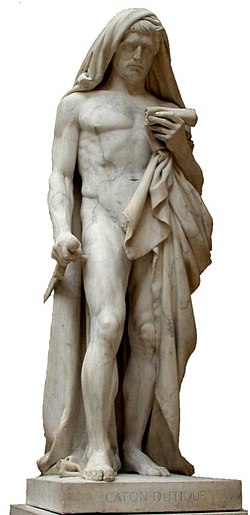
That man was Cato the Younger, or Cato Minor in Latin (as opposed to Cato Major, or Cato the Elder, his great-grandfather). He was a Roman
Stoic statesman, known for both his unflinchingly rigid morality and his full-bore defense of the Republic when
Caesar came to power. For this, he has been venerated for generations. Dante made him the eternal gatekeeper of Purgatory (unlike his fellow pagan philosophers, who were forever in the mild sadness of Limbo). The American Cato Institute is named for him (indirectly). George Washington had
plays about him read to his troops at Valley Forge to encourage them, even though such activities had been prohibited by the Congress. Even today, the man has fans, and I count myself among them.
To be sure, we know much about Cato (compared to many of his contemporaries), though that which we do have can be difficult to decipher.
Plutarch wrote about him in his
Lives, but that wasn't for over a century after his death.
Cicero wrote a supportive pamphlet about him after his death, creatively entitled
Cato, and Julius Caesar responded with his
Anti-Cato. Cicero's is lost to us, and Caesar's only exists in fragments.
Marcus Brutus was dissatisfied with Cicero's attempt so wrote a different supportive pamphlet, which
Octavian (later Caesar Augustus) responded to in the negative, just as his great-uncle Caesar had done.
What we learn from the man is impressive and should be reflected on today. For a time, he served as a
military tribune, and Plutarch notes that when he left, "he was sent on his way, not with blessings, as is common, nor yet with praises, but with tears and insatiable embraces, the soldiers casting their mantles down for him to walk upon, and kissing his hands, things which the Romans of that day rarely did." This is because he "willingly shared the tasks which he imposed upon others, and in his dress, way of living, and conduct on the march, made himself more like a soldier than a commander....In this way, without knowing it, he produced in his men at the same time the feeling of good will towards himself.
For genuine desire to attain virtue arises only in consequence of perfect good will and respect for him who displays virtue."
He returned to Rome and became a
quaestor, fulfilling his role marvelously--hacking away at waste and corruption of the public funds. He was there for a year, and then stepped down, lauded by the public for his incorruptibility. Having been quaestor, he was automatically a member of the Senate as well. He aligned himself quickly with the
Optimates, the conservatives who had supported
Sulla's dictatorship. He, however, since his childhood, had hated Sulla, and sought to return the
Optimates to their pure republican roots. He was elected as
tribune of the plebians in 63BC and assisted his friend Marcus Cicero (consul at the time) in rounding up the members of the
Catiline Conspiracy. In one of his first debates with Julius Caesar, he argued that conspirators should be put to death, even though they were Roman citizens. Caesar believed that imprisonment and exile would suffice, for taking the life of a citizen was reprehensible and contrary to law. Cato, however, won the Senate to his side by pointing out that were the conspirators allowed to live, they may well succeed in destroying the Republic and the laws for which it stood. Breaking the law was, in effect, the only way to preserve the law.
Cato's and Caesar's personal and political feud began at that point. It was exacerbated when, intent on propriety within the Senate, Cato accused Caesar of reading personal notes from the conspirators while the body was in session. He pulled the paper from Caesar's hands, only to find that the note was from Cato's half-sister, who was also Caesar's mistress. Caesar was known to take in his political rivals' wives and family to gain traction against them. Angered and embarrassed, Cato's and Caesar's mutual dislike only increased.
When Caesar attempted to return to Rome with both a
Triumph and a consulship, Cato filibustered, speaking all night so that the Senate could not vote for Caesar to run for consul
in absentia. Caesar was forced to enter the city peacefully, foregoing the Triumph, to run for consul. He won that election, to Cato's dismay.
According to Wikipedia (always the best source, I know...):
When Caesar became consul, Cato opposed the agrarian laws that established farmlands for Pompey's veterans on public lands in Campania, from which the republic derived a quarter of its income. Caesar responded by having Cato dragged out by lictors while Cato was making a speech against him at the rostra. Many senators protested this extraordinary and unprecedented use of force by leaving the forum, one senator proclaiming he'd rather be in jail with Cato than in the Senate with Caesar. Caesar was forced to relent but countered by taking the vote directly to the people, bypassing the Senate. Bibulus and Cato attempted to oppose Caesar in the public votes but were harassed and publicly assaulted by Caesar's retainers.
As the Triumvirate formed, Cato and the
Optimates attempted to force a schism between
Pompey and Caesar. They were ultimately successful, because Pompey feared Caesar's political ambitions. In 49BC, Cato convinced the Senate to strip Caesar of his expired command. Were he to enter Rome again, he would do so without legal immunity. This was to have devastating consequences.
Caesar's army, for its part, was still loyal to him. Though he attempted a compromise with the Senate (which Pompey would have happily given), Cato refused to allow him any power. Forced with the choice between exile and war, Caesar chose to march on Rome. He was declared an enemy of the Republic by the Senate, and many senators, including Cato, soon took to the field with Pompey against him. After Pompey's defeat at the
Battle of Pharsalus in 48BC, Cato escaped to Utica. However, Caesar was close on his tail. Finally, refusing to live in a world devoid of freedom and controlled by Caesar, Cato attempted suicide. An injured hand, however, prevented him from properly stabbing himself, and he was stitched up. According to Plutarch, "when Cato recovered and became aware of this [having been saved], he pushed the physician away, tore his bowels with his hands, rent the wound still more, and so died."
"Give me Liberty or give me Death" was never so true.
The Republic was Cato's love, and his entire life was fought in defense of it. Though his efforts were ultimately unsuccessful, and Rome fell (or rose) into Empire, it should be remembered what James Stewart says in Frank Capra's
Mr. Smith Goes to Washington. "Sometimes the only causes worth fighting for are the lost ones." Certainly a fascinating character of history, easily earning his mantle in the pantheon of political greats.